
Income replacement rate as an indicator of pension adequacy
16.06.2026
Globally, one of the key indicators of pension system adequacy is the Income Replacement Rate (IRR), which reflects the ratio of a pension to a citizen's previously earned income. According to ILO (International Labour Organization) recommendations, a pension is considered adequate if the IRR is at least 40%. In OECD (Organization for Economic Co-operation and Development) countries, the average combined IRR is approximately 60%.
In Kazakhstan, the current IRR, calculated as the ratio of the average combined pension to the average wage in the country, is approximately 44%. This IRR level corresponds to the ILO minimum recommendation, but is lower than in OECD countries.
More than half of the combined IRR is provided by the paid-in pension. However, as the length of service before 1998, which is taken into account when calculating the paid-in pension, decreases for new retirees, the funded pension is becoming increasingly important for them.
The increasing role of pension savings is a global trend. This is due to changing demographics and labor markets, leading to the financial instability of pay-as-you-go (practice-based, insurance-based) systems. According to international studies, the number of countries that have implemented mandatory pension savings for citizens has grown from 17 in 1999 to more than 50 today.
In a funded system, the size of a future pension directly depends on the amount of savings in an individual pension savings account. Savings grow through pension contributions and investment income; they are owned by citizens, which encourages them to save.
To ensure a decent pension, three key conditions are essential:
- duration of participation in the system throughout one's working life;
- regular payment of contributions (preferably monthly, 12 times a year);
- full payment of contributions from all earned income.
Long-term actuarial calculations by the OECD[1] demonstrate the dependence of the IRR on the pension contribution rate, duration, and regularity of contributions (diagram below). OECD calculations show that continuous participation in a funded pension system and regular contribution payments over a long period significantly increase future pensions.
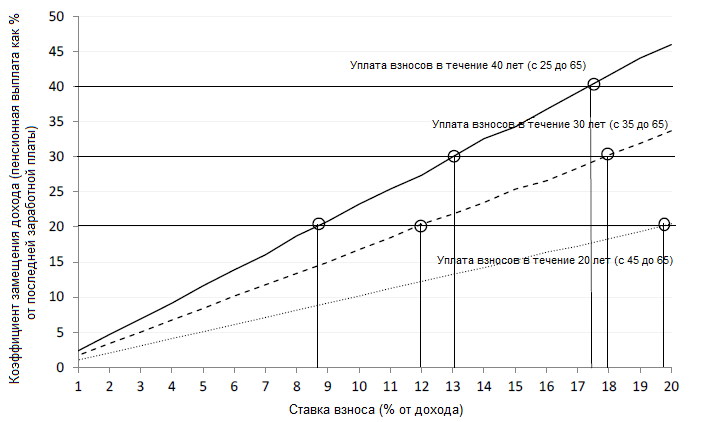
Income replacement rate, contribution rate and frequency
As the diagram shows, to achieve an IRR of at least 30% from funded pensions alone, pension contributions must be paid:
1) at a rate of at least 13% for 40 years;
2) or at a rate of at least 18% for 30 years.
It should be noted that the contribution rates used in international practice correspond to the OECD calculations. For example, in OECD countries, the average pension contribution rate is 18.8%, while in countries with advanced pension systems included in the Mercer CFA Institute Global Pension Index (MCGPI) 2025, the average rate is approximately 17-18%.
Kazakhstan is implementing measures to gradually increase the minimum basic pension from 2023 to 2027 (from 54% to 70%, and the maximum pension from 100% to 120% of the subsistence minimum).
In many countries, pension systems involve not only employees but also employers, who also make contributions to their employees. Therefore, in line with international practice and calculations, Kazakhstan has introduced employer’s compulsory pension contributions (ECPC) in addition to employee’s compulsory pension contributions (CPC), with a gradual increase in the contribution rate from 1.5% to 5% from 2024 to 2028. The contribution rates (10% CPC and 5% ECPC) are now in line with international practice and OECD actuarial calculations.
As a result, in Kazakhstan's multi-pillar pension system, responsibility for pensions is shared between the state, employer, and employee.
[1] Source: OECD REVIEWS OF PENSION SYSTEMS: MEXICO © OECD 2015